The short answer
You don't strictly need a website. A Google Business Profile is free to add or claim, and it can put your hours, phone number, location, photos and reviews in front of people searching on Google Search and Maps. For some businesses that's enough, at least for a while.
But a profile and a website aren't the same thing. A profile is a listing that lives on Google, in Google's format, under Google's rules. A website is yours. They do different jobs, and each covers what the other can't.
Here is what each does well, where each falls short, and how to set both up without spending much time.
What a Google Business Profile does well
Google describes the Business Profile as a way to manage how your business information appears across Google, including Search and Maps. That's its strength: it shows up right where people look for a nearby business.
- It holds the basics: your category, hours, special hours for holidays, phone numbers, and your address or service area.
- It has room for a description of up to 750 characters.
- Customers can leave reviews, and you can reply to them.
- Food and drink businesses can add a menu with sections, descriptions and prices.
- Some categories can add links for online orders, reservations or appointments.
- Photos show once your business is verified.
Google also says businesses with complete and accurate info are more likely to show up in local search results. A profile with every field filled in is worth the effort.
Where a profile falls short
A profile works inside Google's layout and rules. That's fine for the basics, but it has limits:
- You fill in the fields Google offers, but you don't decide how the listing looks.
- The description has rules: no web addresses or HTML, no more than 750 characters, and it should be about your business rather than promotions, prices or sales.
- It isn't the place for your full story or detailed policies, like deposits, cancellations or warranties.
- It only exists on Google. Apple Maps and Bing have their own listings, managed separately: Apple Business for Apple Maps, and Bing Places for Business for Bing Search and Bing Maps.
What a website does well
A website is the one place online that you control. You decide what's on it, in what order, and how it looks.
- Room to explain: your full menu or list of services with prices, your story, your credentials, the area you serve, your policies.
- Your own ways to be contacted: call and directions buttons, a quote request form, links to book or order.
- One address that works everywhere: on your van, your flyers, your invoices, your Instagram bio, a QR code in the window.
- It can be found through any search engine, not only Google.
- It gives your profile somewhere to send people. Google asks that the website on your profile represent your individual business location, not a link that redirects people somewhere else.
When a profile alone can be enough
Some businesses really do fine with only a profile, at least to start. It can be enough when most customers find you by searching your name or browsing Google Maps, your offer is simple and rarely changes, and you keep the profile up to date. Three examples:
- A takeout counter with a short menu that hasn't changed in years.
- A one-chair barbershop where regulars book by calling.
- A mobile mechanic who works in one town and gets most jobs by word of mouth.
Even then, check Google's eligibility guidelines first. A rented mailing address you don't operate from (a virtual office) isn't eligible, and a service-area business should hide its address from customers.
The trade-off: what people can read about you online is limited to what fits in Google's fields. When you want to say more, or be found outside Google, that's the moment for a website.
Why they work better together
The two support each other. Your profile catches people at the moment they search. Your website gives them the detail they need to decide, and a way to get in touch on your terms.
Link them: add your website's address to your profile, and put the same name, address, phone and hours on both. Google's guidelines say your business name should reflect your real-world name, as used consistently on your storefront, website and stationery. And if your website says you close at 9 while your profile says 10, someone will arrive at a locked door.
Google says prominence, one of the main things local results are based on, also draws on info like how many websites link to your business. A website gives a local news story or a community group an obvious place to link. None of this guarantees a ranking.
A simple plan if you have neither
If you're starting from nothing, here is an order that works:
- Add or claim your Google Business Profile at business.google.com/add, at no charge.
- Verify it. Google decides which options you get (phone or text, email, a live video call or mail), and reviews can take up to 5 business days.
- Fill in every field you can: category, hours, phone, description and real photos.
- Make a simple website with the same details, plus your menu or services, a short about section and an easy way to contact you.
- Add the website's address to your profile.
- Ask real customers for reviews, never in exchange for a discount or a freebie, and reply to them.
- Whenever your hours, prices or phone number change, update both on the same day.
Where Suddn fits
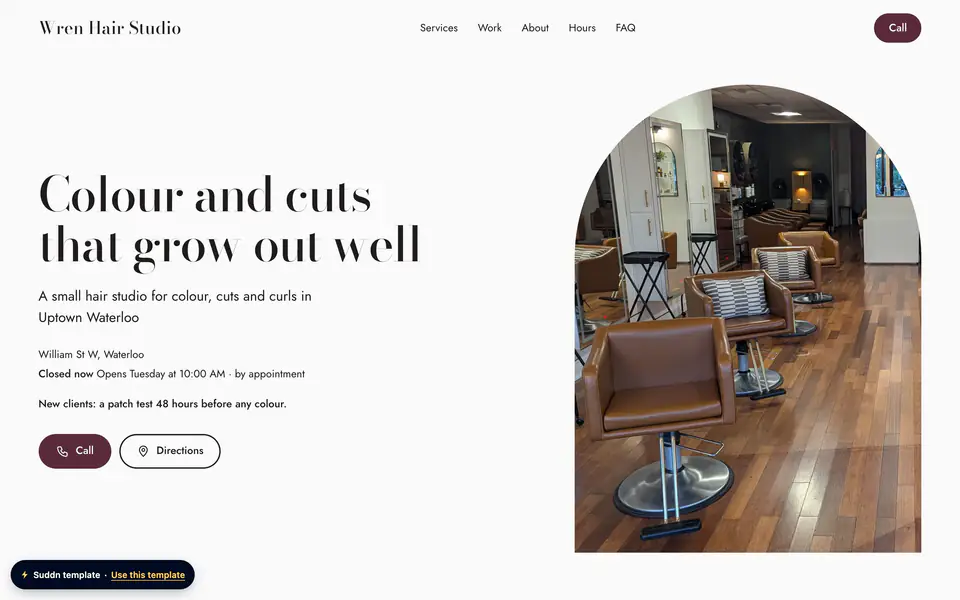
The website half doesn't have to be a big project. Suddn builds one from your business name, the kind of business, your phone number and your city in under a minute, and you add the rest later from your phone. The Free plan is a one-page website at yourname.suddn.page with your hours, location, call and directions buttons and FAQ, and you can put its address straight into your Google Business Profile. During early access you can build and save it, and we'll email you when you can publish. Any website that's accurate and easy to use on a phone will do the job.
In short
- A Google Business Profile is free and shows your hours, phone, location, photos and reviews on Google Search and Maps.
- A profile follows Google's format and rules; a website is yours to arrange, and any search engine can find it.
- Some simple businesses can manage with a profile alone, at least to start.
- Used together, link them to each other and keep the name, address, phone and hours identical.